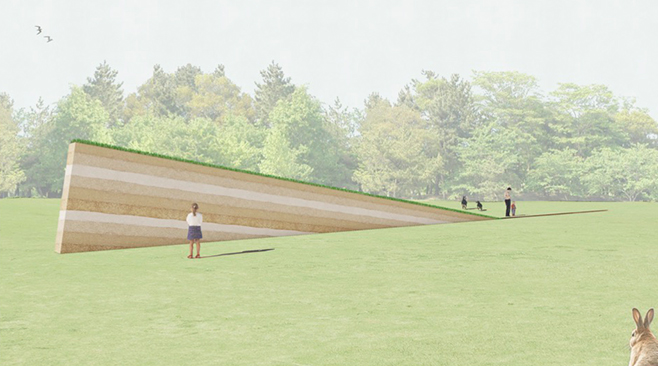
What form does a monument of the earth take when it emerges within the nature of Mount Rokko? Historically, Mount Rokko was a thriving site for granite quarrying. During the mid-Edo period, excessive quarrying and deforestation led to severe environmental degradation. It was not until the Meiji era that the scarred landscape was painstakingly restored through human reforestation, transforming it back into the lush greenery we see today.

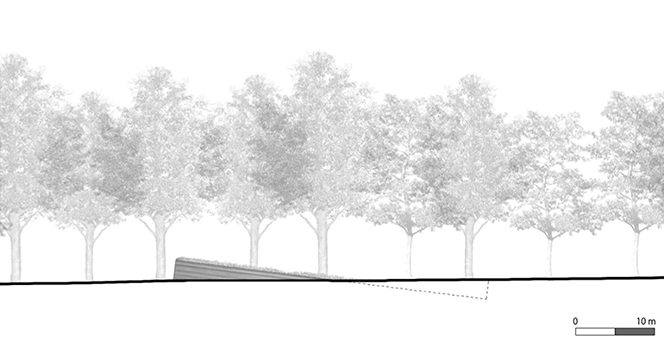
The wall, rising sharply from the ground, is constructed using the Rammed Earth technique, utilizing soil sourced directly from the Rokko region. The gradations of color on its surface evoke the geological strata accumulated over countless millennia. This structure gives a voice to the shared history of humanity and nature, posing questions about the future that lies ahead.

By manifesting a wall in a place once destroyed and subsequently restored by humans, it serves as a catalyst for the gathering of plants, animals, and people. This monument, draped in the memory of the earth, is not limited to Rokko; it could exist anywhere on this planet. In the midst of a "polycrisis" (permacrisis) where global balance is profoundly shaken, there is much for humanity to learn—from the accumulated memories of the earth to the microscopic worlds of insects and flora.

The upheaval of this "Wall of Memory" creates a rich sanctuary for the life inhabiting Rokko, before eventually returning to the earth as a transient event.


六甲の自然のなかに立ち現れる大地のモニュメントとはどのようなものか。かつて六甲山では花崗岩の採石が盛んであった。江戸時代の中期、過剰な採石に伴って森林が伐採され自然の荒廃を招いたという歴史がある。明治時代に入り、その荒廃した山肌は人々の手によって植林が行われ緑豊かなものに再生された。

地中から鋭角に隆起した壁は、六甲の地より産出する土を用いたRammed Earthの構法によってつくられる。その表面に現れる色の濃淡は、長年かけて幾重にも積み重なった地層を想起させる。そして人と自然が共に歩んできた歴史に声を与え、これから訪れる未来について問いかけるであろう。人間が壊し人間が再生した場所に、動植物や人々の集まる契機としての壁が現出すること。それは六甲の地に限らず、地球上のどこにでも成立する大地の記憶を纏ったモニュメントとなり得るのではないだろうか。世界の均衡が大きく揺らいだパーマクライシスの渦中にいる人類が、堆積した大地の記憶・虫や動植物などの小さな世界から学ぶことは決して少なくない。この記憶の壁の隆起は、六甲に存在する生命に豊かな居場所を創出し、一過性の出来事として再び大地へと還ってゆく。